


Shear-Sensitive Pumping with Peristaltic Pumps
Factors Impacting Shear Sensitivity
Peristaltic pumps have become the gold standard for shear-sensitive pumping applications where damage to cells or agitation of a suspension or colloidal mixture may interfere with the science being performed. Shear sensitivity concerns are especially common in live cell circulation within a bioreactor or food and beverage suspensions in manufacturing applications. Inherently, peristaltic pump technology provides gentle pumping action at low speeds, especially when compared to other positive displacement pumps which use tightly machined gears or high-speed impellers to move liquids. However, when it comes to providing the maximum protection to sensitive fluids not all peristaltic pumps are designed equally.
Many methods are available to compare shear forces within pumps. In this case, hemolysis of blood cells was used to evaluate the sensitivity of several pump designs for live cell circulation. In vitro testing was completed using citrated bovine blood circulated through several peristaltic pump systems and settings to establish optimal conditions. All testing was completed in accordance with ASTM F756-13 (Standard Practice for Assessment of Hemolytic Properties of Materials) and FDA 21 CFR Part 58 (Good Laboratory Practice for Nonclinical Laboratory Studies) by an ANSI-ASQ National Accreditation Board (ANAB)- accredited laboratory.
The performance of each pump system was evaluated against its Average Hemolytic Index (a measure of the percentage of hemolysis of the blood cells) for 180 minutes.
1 - Pump motor speed
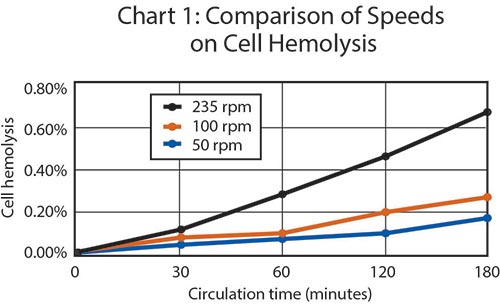
Flow rates in peristaltic pumps are dictated by the rotation speed of the motor, measured in revolutions per minute (rpm). Peristaltic pumps generally present linear flow rates versus rpm with the tubing diameter, number of rollers, and overall occlusion bed size affecting the amount of flow per revolution.
As shown in Chart 1, the motor speed is very dominant in a pump’s ability to maintain cell viability during recirculation.
2 - Pump head occlusion
In a peristaltic pump head, occlusion refers to the space between the two walls of the tubing as the rollers compress the tubing—full occlusion leaves no space between the walls while partial occlusion does not fully compress the two tubing walls together. In practice, full occlusion generates the highest pressure and flow rates as compared to partial occlusion.
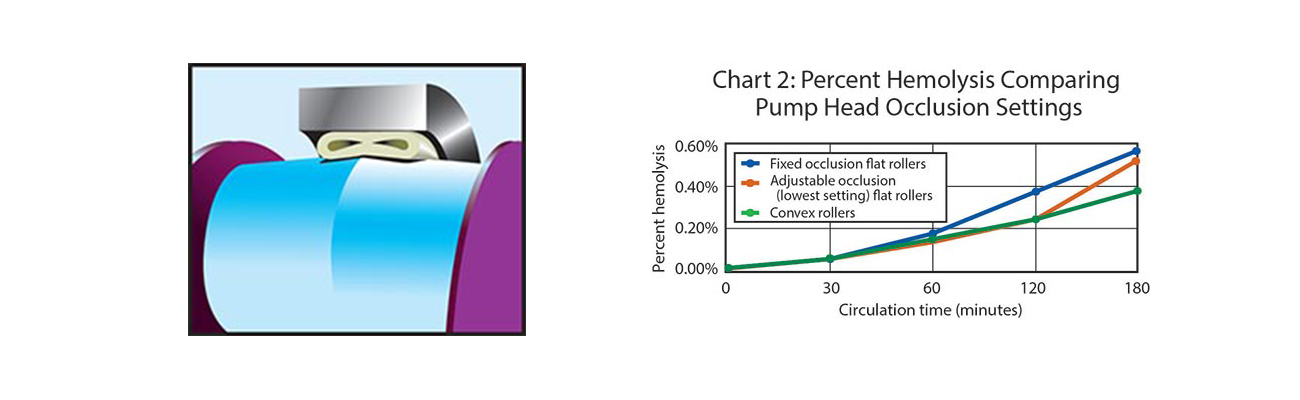
When evaluated for blood cell hemolysis, the pump head occlusion setting was important. Less tubing occlusion allowed space for the blood cells to shift around the force of the roller which decreased the overall percent of hemolysis. Additionally, in longer circulation times the geometry of the occlusion affects the cell viability.
Peristaltic pumps traditionally have flat rollers. The recent introduction of convex rollers has improved performance in shear-sensitive applications. Flat rollers perform best in most applications, delivering superior dispensing accuracy, maximum pressure capabilities, and higher flow rates. However, convex rollers function similarly to adjustable occlusion pump heads in creating space for cells to move during compression of the tubing (Figure 1). The result is improved cell viability during recirculation with convex rollers.
Chart 2 compares the effect of flat rollers versus convex rollers on pumps running at the same speed. In this case, equipping a pump head with less than full occlusion improves cell viability 10-25%.
Comparing Masterflex Pump Heads and Shear-Sensitive Performance
1 - Masterflex L/S Easy-Load II pump head
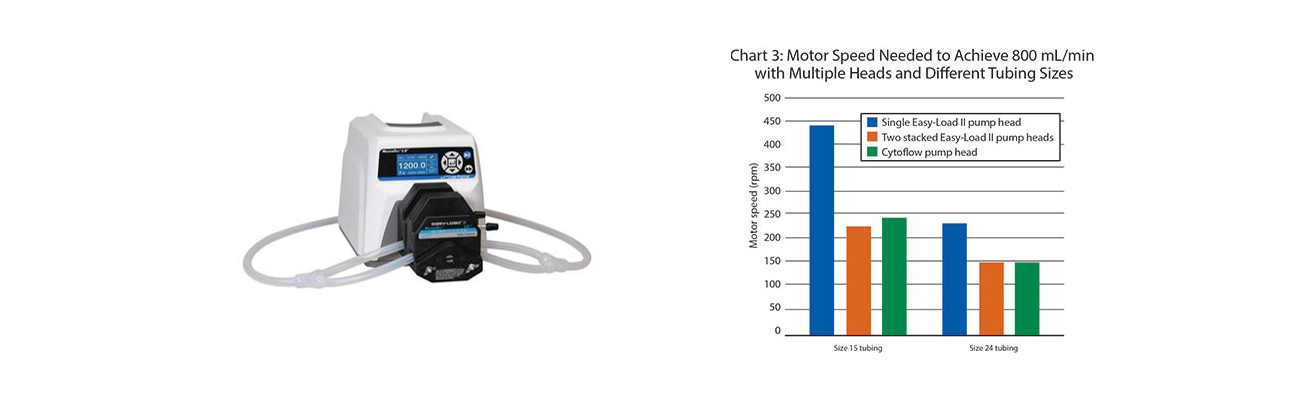
The Masterflex Easy-Load II pump head is among the most common peristaltic pump heads on the market, used extensively in perfusion, bioreactor, and cell suspension applications. This flat-roller pump head can be optimized for cell viability by minimizing the drive’s motor speed needed to achieve the targeted flow rate. This can be done using one of the two effective techniques below:
- Use two stacked pumps heads connected with a double-Y tubing assembly (Figure 2).
- Use the largest diameter tubing the process will allow.
Figure 2 - Masterflex Peristaltic pump system with two Easy-Load II stacked pump heads.
Chart 3 shows how using these two techniques can dramatically limit the speed of the pump when targeting a flow rate of 800 mL per minute.
The Masterflex Easy-Load II pump head can be further optimized by choosing the adjustable occlusion model and reducing the occlusion as much as the process conditions will allow.
2 - Masterflex L/S Cytoflow pump head
The Masterflex Cytoflow pump head (Figure 3) was developed specifically for applications where cell viability is essential. The pump head provides all of the benefits of peristaltic pumps that have made them ideal for use in biopharm and microbiology applications, while adding features that optimize performance for live cell pumping.
The Cytoflow pump head has an extra-large tubing bed and fewer rollers, resulting in high flow rates like using two stacked Easy-Load II heads (see Chart 3) but without the inconvenience of introducing a “Y” pattern in the fluid path. The pump head is available in 2- and 3-roller configurations—more rollers reduce pulsation but limit the flow rate achieved. In addition to the high flow rates at low motor speeds, the Cytoflow pump head has a convex roller design, furthering its cell viability advantages. This combination makes the Cytoflow pump head the best choice for pump operators looking to minimize the impact on live cells.

Conclusion and Recommendations for Shear-Sensitive Applications
Maximizing cell viability with peristaltic pumps requires a multivariate solution with major contributors following this order:
- Pump motor speed: lower rpm minimizes hemolysis
- Occlusion settings: lower occlusion minimizes hemolysis
- Occlusion geometry: convex roller design optimizes cell viability during recirculation